Game Changers
More To Play For
Padel is becoming more than a game. We meet Florent Prelo at Palaestra in Koh Samui to talk about the culture, community and chemistry forming around the court.
Padel is becoming more than a game. We meet Florent Prelo at Palaestra in Koh Samui to talk about the culture, community and chemistry forming around the court.
By
Sarah Angus
•
6 min read
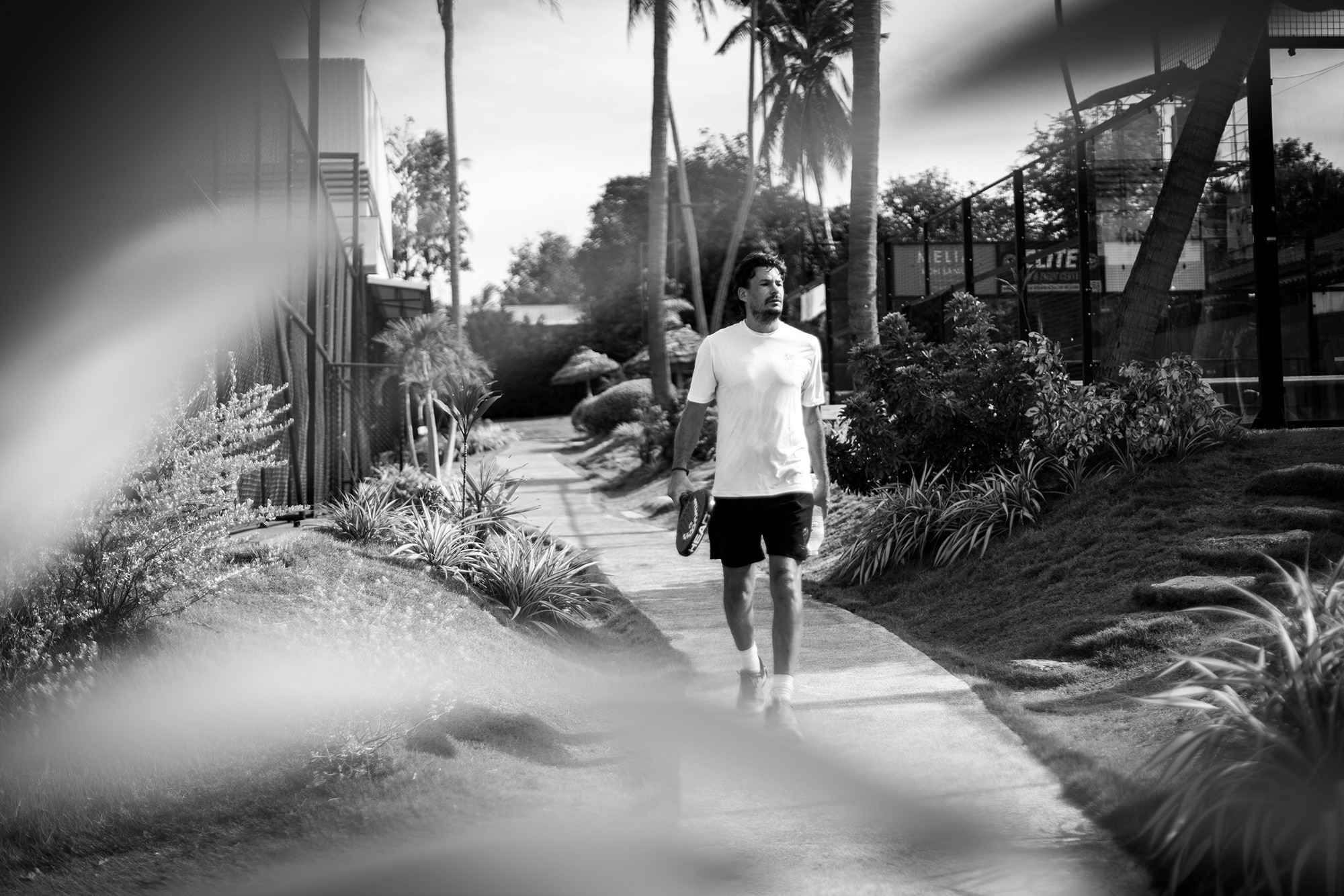
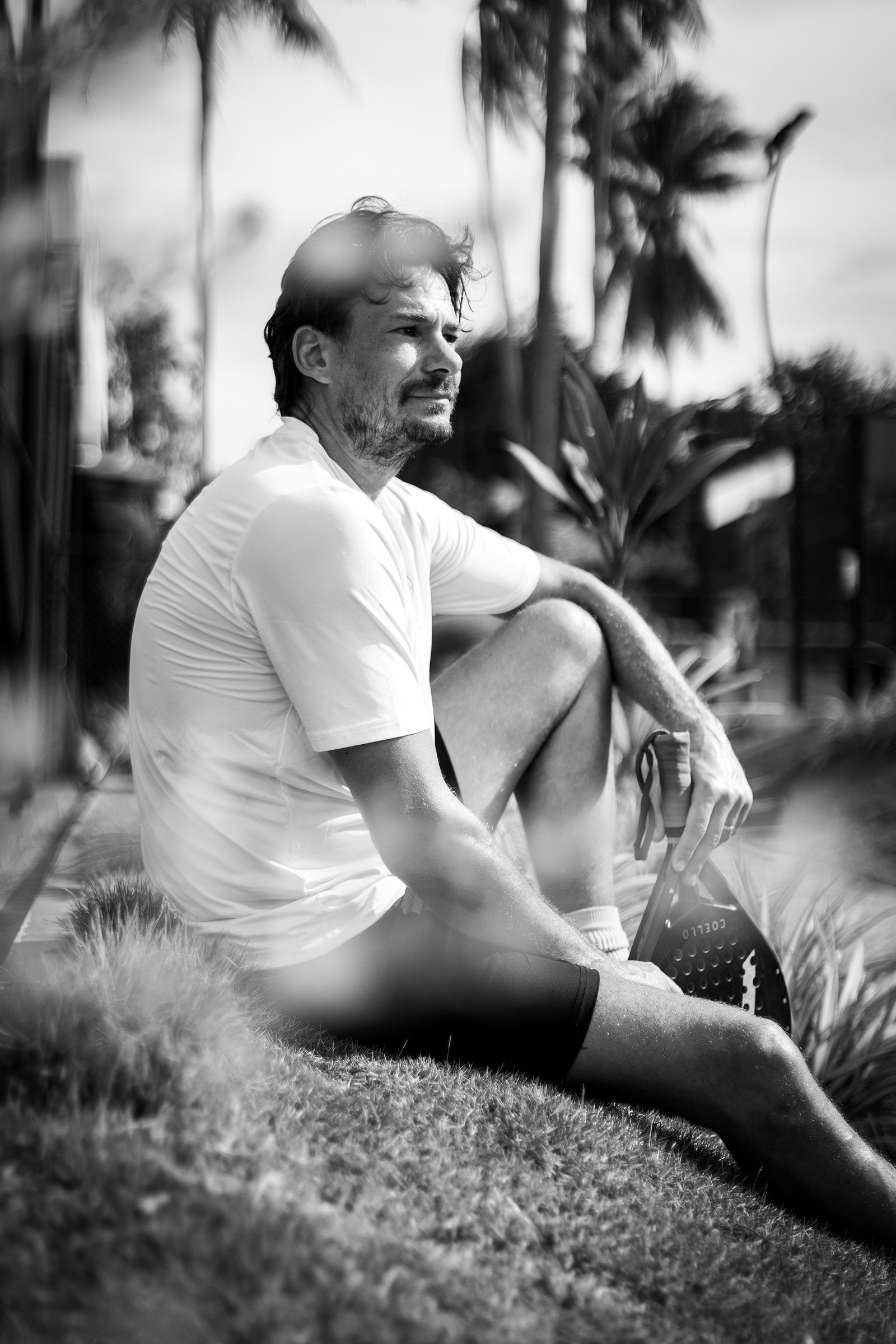
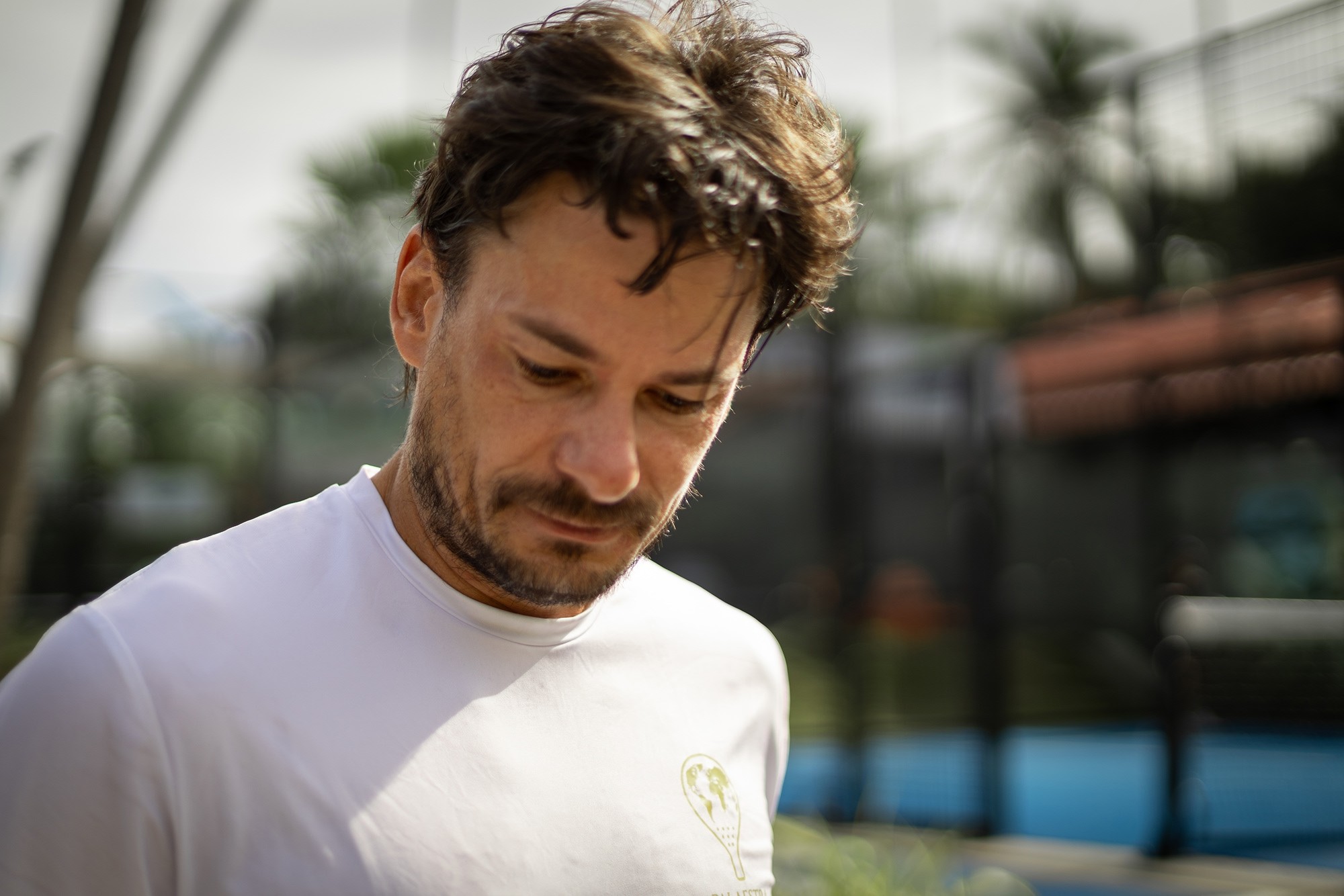
Padel has a habit of turning a game into something more social. Ninety minutes on court quickly becomes a drink at the bar, four players become a group chat, and somewhere between the competition and conversation, a community forms. It’s this particular chemistry that fascinates Florent Prelo, Founder and Head Coach of Palaestra, the padel club and retreat in Koh Samui, Thailand. A relative latecomer to the game, Florent believes its success lies in something other sports have struggled to get quite right: taking the competition seriously, without taking itself too seriously. For Valera’s inaugural interview, Co-founder, Matt Rock met Florent at Palaestra to talk about why we’re all playing, what keeps us coming back and the culture forming around the court.
You’ve only been involved in padel for four years and your FIP ranking is 1,463. What happened when you first encountered it that made you think: there’s something here?
I was completely obsessed with tennis. I’m very competitive and I wanted a sport where I could see myself improving quickly and prove things to myself. Then I moved to Koh Samui and what I needed from sport changed. I wanted something more social, somewhere I could meet people and improve my English, but also something I could share with my wife.
I’d actually tried padel once in Switzerland about 15 years ago and didn’t get it at all. But in Samui my wife became really addicted to it and so I started playing more too. Being able to play together, or against each other, was a big part of it. With tennis, it was always just me.
Padel suddenly gave me several things at once: competition, an easy way to meet people and a sport I could share with my wife. I came to Samui still wanting to improve my tennis, but gradually I found myself wanting to play padel instead.

What did you see in padel that you hadn’t found elsewhere?
I call it the tactical puzzle. At first you think it’s about hitting good shots, but the better you get, the more you realise it’s about positioning, consistency and reading the game. How do you force someone else to take the risk without making the error yourself? It’s not about raw power or trying to hit crazy shots. A lot of the time it’s about making fewer mistakes and making the right decision.
I started watching P1 tournaments and studying matches on YouTube. With tennis, you can watch the professionals, but what they’re doing can feel like a completely different sport. With padel, you can watch the best players in the world, understand the decisions they’re making and then try some of those ideas in your own game.
It’s accessible enough that you can start playing and enjoying yourself very quickly, but underneath that there’s enormous technical and tactical depth. The more I understood it, the more there was to understand. That really appealed to me.
At what point did you stop seeing just a game and start seeing everything happening around it?
I think it came from frustration with my own game. I could hit an amazing shot and then make three mistakes straight after. I wanted to play with better players, but I wasn’t consistent enough, so I had to start simplifying everything. I started thinking much more about positioning, where to put the ball and when not to attack.
Then I realised that so many adult players have exactly the same problem. You can know how to hit the ball, but that doesn’t mean you understand how to play the game.
At the same time, I started noticing everything happening off the court. People talk about work, about their lives, you get to know each other properly. But somehow the conversation always comes back to padel. Someone will suddenly say, “OK, now I understand what I’m doing wrong,” and then they want to get back on court and try it.
That’s when I started thinking it wasn’t just about coaching. You can learn something in a one-hour lesson, but then you go home. When you have seven days where you’re playing, watching, talking about the game and then playing again, you have time to actually understand what you’re doing and change it.
You’ve watched people arrive, play, eat, recover and spend several days together. What have you learned about padel players that surprised you?

What surprised me is how quickly people start to understand their own game when they’re in a group. Everyone arrives wanting to hit the big smash or win the point, but quite quickly they start to see where they’re making mistakes.
Padel is really a game of mistakes. If you make more than your opponent, you’re probably going to lose. Sometimes I’ll organise a slower game with lower-level players, usually mixed, and that’s when you really see it. People actually make mistakes when they have more time. They have time, so they think, “I can win the point from here.” And usually that’s not true.
Over a week, you start to recognise those patterns. You watch, play, make the mistake and try again. By the end of the week, people understand the game differently: where to put the ball, where to position themselves and, quite often, when not to try to win the point.
If somebody leaves a Palaestra week playing at exactly the same level but having had an extraordinary experience, has the retreat succeeded?
No. Of course, the most important thing is that they’ve had a great time with the other players, the coaches and the staff. The worst thing for me would be somebody leaving Palaestra liking padel less than when they arrived. But I also believe the experience and the progression are linked.
If someone understands what they’re doing wrong, they’re going to want to test it. That’s one reason I prefer working with lower and intermediate players. The more advanced you become, the smaller the margins are. At my level, I know exactly what I need to work on, but making a meaningful improvement in one week is almost impossible. You’re working on tiny details.
With an intermediate player, you can unlock much more. So yes, I want someone to leave saying, “That was an amazing week.” But I also want them to understand their game better. For me, those two things should happen together.
You came into padel at an unusual moment. What do you think is attracting this wave of new players to it?
Padel is easier and more fun than tennis. It’s less brutal than squash. And progression is incredibly fast. People play their first match and feel like they’ve made real progress within a week. For busy professionals, it’s perfect: you get genuine sport, you improve quickly and you don’t have the same learning curve as tennis.
But I think the social side is a huge part of it too. A game lasts 90 minutes and during that time you work out pretty quickly whether you could be friends with the people you’re playing with. Then the match finishes and everyone ends up at the bar for coconut water or whatever it might be. You talk about where you usually play, what you do, where you’re from.
That’s also why it works so well as a networking tool. Better than golf, actually, because you’re playing together, not just walking and talking. It gives people the competition they want, but there’s this social world that comes with it too.

Why do you think hospitality, travel, fashion and wellness are all becoming interested in padel?
Women are a big part of the story. Padel appeals to both men and women, but there’s an aesthetic and social side to the sport that has opened it up to brands you might not have expected to see here. Alo Yoga and Lululemon, for example, came from yoga, but padel gives them this meeting point between fashion, community and performance. Someone might initially come for the clothes, the social side or the Instagram moment, but then they start playing, they improve and suddenly they always want to play.
The same thing is happening in hospitality. Hotels that once had tennis courts are converting them to padel because they can create a whole new experience around the game. The Ritz-Carlton in Dubai, for example, replaced a huge tennis court with three padel courts beside the sea. Club Med is investing heavily in padel too.
And then there’s the bigger shift. Padel has become a third place. Clubs aren’t just courts anymore. You’ve got pools, saunas, wellness centres, coworking spaces. In Asia especially, I’m seeing complex after complex that has everything. It’s almost the new daycare for adults: somewhere you can work, play, recover and be social. Padel is becoming part of a much bigger lifestyle, not just a sport.
There’s a lot of beautiful imagery around padel at the moment. How much of this is genuinely a new culture, and how much is simply a fashionable sport being packaged very well?
I think it’s both. There’s genuinely good packaging happening, but there’s also real culture underneath. What’s different about padel is that it’s accessible in a way tennis never was. Women play. Competitive players play alongside casual players. You can reach international competition quickly.
Is there hype and beautiful marketing? Of course. But the hype is responding to something real. The market will segment like tennis did. There will be high-end clubs and there will be courts everywhere. Palaestra is in the premium segment, curating the best experiences, and that’s fine. The accessibility and the hype can both be true.
As padel grows, what do you think we need to protect?
The accessibility and the social element. If padel became about ego and gatekeeping, if good players stopped playing with less experienced ones, that would kill it for me.
You can walk into a padel club and within weeks be playing matches. You can be competitive immediately. And importantly, experienced players don’t gatekeep. They play with newcomers and want to help them progress because the game is more fun that way.
I think that’s what separates padel from tennis. Protect that and everything else takes care of itself.

Strip away Palaestra and the business. When is padel at its absolute best for you?
Firstly, it’s the international tournaments. I’ve competed at a really high level internationally, something tennis never would have let me do at this point in my life. That feeling of living like a pro, competing seriously, is extraordinary.
Secondly, playing with my wife. Not just alongside her, but with her as a partner, competing together, especially when we win. That partnership element is everything.
And there’s a moment that keeps happening where you watch someone suddenly understand their game. That shift from confusion to clarity is when padel is at its best.
Do you believe Palaestra will fundamentally change how adults experience padel?
Not globally, no. That’s not really the ambition. But for a certain type of person, absolutely. Someone who’s competitive, who really wants to improve their game, but also wants to be around people who think in the same way and have an amazing week while they’re doing it.
We’re not trying to make Palaestra big just for the sake of being big. I’d much rather keep it selective and really think about every part of the experience. The goal is to be the best at what we do, and for people to leave feeling like something has genuinely changed in their game. That’s much more important to me than scale.
Find out more at: palaestra.fr
Padel has a habit of turning a game into something more social. Ninety minutes on court quickly becomes a drink at the bar, four players become a group chat, and somewhere between the competition and conversation, a community forms. It’s this particular chemistry that fascinates Florent Prelo, Founder and Head Coach of Palaestra, the padel club and retreat in Koh Samui, Thailand. A relative latecomer to the game, Florent believes its success lies in something other sports have struggled to get quite right: taking the competition seriously, without taking itself too seriously. For Valera’s inaugural interview, Co-founder, Matt Rock met Florent at Palaestra to talk about why we’re all playing, what keeps us coming back and the culture forming around the court.
You’ve only been involved in padel for four years and your FIP ranking is 1,463. What happened when you first encountered it that made you think: there’s something here?
I was completely obsessed with tennis. I’m very competitive and I wanted a sport where I could see myself improving quickly and prove things to myself. Then I moved to Koh Samui and what I needed from sport changed. I wanted something more social, somewhere I could meet people and improve my English, but also something I could share with my wife.
I’d actually tried padel once in Switzerland about 15 years ago and didn’t get it at all. But in Samui my wife became really addicted to it and so I started playing more too. Being able to play together, or against each other, was a big part of it. With tennis, it was always just me.
Padel suddenly gave me several things at once: competition, an easy way to meet people and a sport I could share with my wife. I came to Samui still wanting to improve my tennis, but gradually I found myself wanting to play padel instead.
What did you see in padel that you hadn’t found elsewhere?
I call it the tactical puzzle. At first you think it’s about hitting good shots, but the better you get, the more you realise it’s about positioning, consistency and reading the game. How do you force someone else to take the risk without making the error yourself? It’s not about raw power or trying to hit crazy shots. A lot of the time it’s about making fewer mistakes and making the right decision.
I started watching P1 tournaments and studying matches on YouTube. With tennis, you can watch the professionals, but what they’re doing can feel like a completely different sport. With padel, you can watch the best players in the world, understand the decisions they’re making and then try some of those ideas in your own game.
It’s accessible enough that you can start playing and enjoying yourself very quickly, but underneath that there’s enormous technical and tactical depth. The more I understood it, the more there was to understand. That really appealed to me.
At what point did you stop seeing just a game and start seeing everything happening around it?
I think it came from frustration with my own game. I could hit an amazing shot and then make three mistakes straight after. I wanted to play with better players, but I wasn’t consistent enough, so I had to start simplifying everything. I started thinking much more about positioning, where to put the ball and when not to attack.
Then I realised that so many adult players have exactly the same problem. You can know how to hit the ball, but that doesn’t mean you understand how to play the game.
At the same time, I started noticing everything happening off the court. People talk about work, about their lives, you get to know each other properly. But somehow the conversation always comes back to padel. Someone will suddenly say, “OK, now I understand what I’m doing wrong,” and then they want to get back on court and try it.
That’s when I started thinking it wasn’t just about coaching. You can learn something in a one-hour lesson, but then you go home. When you have seven days where you’re playing, watching, talking about the game and then playing again, you have time to actually understand what you’re doing and change it.
You’ve watched people arrive, play, eat, recover and spend several days together. What have you learned about padel players that surprised you?
What surprised me is how quickly people start to understand their own game when they’re in a group. Everyone arrives wanting to hit the big smash or win the point, but quite quickly they start to see where they’re making mistakes.
Padel is really a game of mistakes. If you make more than your opponent, you’re probably going to lose. Sometimes I’ll organise a slower game with lower-level players, usually mixed, and that’s when you really see it. People actually make mistakes when they have more time. They have time, so they think, “I can win the point from here.” And usually that’s not true.
Over a week, you start to recognise those patterns. You watch, play, make the mistake and try again. By the end of the week, people understand the game differently: where to put the ball, where to position themselves and, quite often, when not to try to win the point.
If somebody leaves a Palaestra week playing at exactly the same level but having had an extraordinary experience, has the retreat succeeded?
No. Of course, the most important thing is that they’ve had a great time with the other players, the coaches and the staff. The worst thing for me would be somebody leaving Palaestra liking padel less than when they arrived. But I also believe the experience and the progression are linked.
If someone understands what they’re doing wrong, they’re going to want to test it. That’s one reason I prefer working with lower and intermediate players. The more advanced you become, the smaller the margins are. At my level, I know exactly what I need to work on, but making a meaningful improvement in one week is almost impossible. You’re working on tiny details.
With an intermediate player, you can unlock much more. So yes, I want someone to leave saying, “That was an amazing week.” But I also want them to understand their game better. For me, those two things should happen together.
You came into padel at an unusual moment. What do you think is attracting this wave of new players to it?
Padel is easier and more fun than tennis. It’s less brutal than squash. And progression is incredibly fast. People play their first match and feel like they’ve made real progress within a week. For busy professionals, it’s perfect: you get genuine sport, you improve quickly and you don’t have the same learning curve as tennis.
But I think the social side is a huge part of it too. A game lasts 90 minutes and during that time you work out pretty quickly whether you could be friends with the people you’re playing with. Then the match finishes and everyone ends up at the bar for coconut water or whatever it might be. You talk about where you usually play, what you do, where you’re from.
That’s also why it works so well as a networking tool. Better than golf, actually, because you’re playing together, not just walking and talking. It gives people the competition they want, but there’s this social world that comes with it too.
Why do you think hospitality, travel, fashion and wellness are all becoming interested in padel?
Women are a big part of the story. Padel appeals to both men and women, but there’s an aesthetic and social side to the sport that has opened it up to brands you might not have expected to see here. Alo Yoga and Lululemon, for example, came from yoga, but padel gives them this meeting point between fashion, community and performance. Someone might initially come for the clothes, the social side or the Instagram moment, but then they start playing, they improve and suddenly they always want to play.
The same thing is happening in hospitality. Hotels that once had tennis courts are converting them to padel because they can create a whole new experience around the game. The Ritz-Carlton in Dubai, for example, replaced a huge tennis court with three padel courts beside the sea. Club Med is investing heavily in padel too.
And then there’s the bigger shift. Padel has become a third place. Clubs aren’t just courts anymore. You’ve got pools, saunas, wellness centres, coworking spaces. In Asia especially, I’m seeing complex after complex that has everything. It’s almost the new daycare for adults: somewhere you can work, play, recover and be social. Padel is becoming part of a much bigger lifestyle, not just a sport.
There’s a lot of beautiful imagery around padel at the moment. How much of this is genuinely a new culture, and how much is simply a fashionable sport being packaged very well?
I think it’s both. There’s genuinely good packaging happening, but there’s also real culture underneath. What’s different about padel is that it’s accessible in a way tennis never was. Women play. Competitive players play alongside casual players. You can reach international competition quickly.
Is there hype and beautiful marketing? Of course. But the hype is responding to something real. The market will segment like tennis did. There will be high-end clubs and there will be courts everywhere. Palaestra is in the premium segment, curating the best experiences, and that’s fine. The accessibility and the hype can both be true.
As padel grows, what do you think we need to protect?
The accessibility and the social element. If padel became about ego and gatekeeping, if good players stopped playing with less experienced ones, that would kill it for me.
You can walk into a padel club and within weeks be playing matches. You can be competitive immediately. And importantly, experienced players don’t gatekeep. They play with newcomers and want to help them progress because the game is more fun that way.
I think that’s what separates padel from tennis. Protect that and everything else takes care of itself.
Strip away Palaestra and the business. When is padel at its absolute best for you?
Firstly, it’s the international tournaments. I’ve competed at a really high level internationally, something tennis never would have let me do at this point in my life. That feeling of living like a pro, competing seriously, is extraordinary.
Secondly, playing with my wife. Not just alongside her, but with her as a partner, competing together, especially when we win. That partnership element is everything.
And there’s a moment that keeps happening where you watch someone suddenly understand their game. That shift from confusion to clarity is when padel is at its best.
Do you believe Palaestra will fundamentally change how adults experience padel?
Not globally, no. That’s not really the ambition. But for a certain type of person, absolutely. Someone who’s competitive, who really wants to improve their game, but also wants to be around people who think in the same way and have an amazing week while they’re doing it.
We’re not trying to make Palaestra big just for the sake of being big. I’d much rather keep it selective and really think about every part of the experience. The goal is to be the best at what we do, and for people to leave feeling like something has genuinely changed in their game. That’s much more important to me than scale.
Find out more at: palaestra.fr
Padel has a habit of turning a game into something more social. Ninety minutes on court quickly becomes a drink at the bar, four players become a group chat, and somewhere between the competition and conversation, a community forms. It’s this particular chemistry that fascinates Florent Prelo, Founder and Head Coach of Palaestra, the padel club and retreat in Koh Samui, Thailand. A relative latecomer to the game, Florent believes its success lies in something other sports have struggled to get quite right: taking the competition seriously, without taking itself too seriously. For Valera’s inaugural interview, Co-founder, Matt Rock met Florent at Palaestra to talk about why we’re all playing, what keeps us coming back and the culture forming around the court.
You’ve only been involved in padel for four years and your FIP ranking is 1,463. What happened when you first encountered it that made you think: there’s something here?
I was completely obsessed with tennis. I’m very competitive and I wanted a sport where I could see myself improving quickly and prove things to myself. Then I moved to Koh Samui and what I needed from sport changed. I wanted something more social, somewhere I could meet people and improve my English, but also something I could share with my wife.
I’d actually tried padel once in Switzerland about 15 years ago and didn’t get it at all. But in Samui my wife became really addicted to it and so I started playing more too. Being able to play together, or against each other, was a big part of it. With tennis, it was always just me.
Padel suddenly gave me several things at once: competition, an easy way to meet people and a sport I could share with my wife. I came to Samui still wanting to improve my tennis, but gradually I found myself wanting to play padel instead.
What did you see in padel that you hadn’t found elsewhere?
I call it the tactical puzzle. At first you think it’s about hitting good shots, but the better you get, the more you realise it’s about positioning, consistency and reading the game. How do you force someone else to take the risk without making the error yourself? It’s not about raw power or trying to hit crazy shots. A lot of the time it’s about making fewer mistakes and making the right decision.
I started watching P1 tournaments and studying matches on YouTube. With tennis, you can watch the professionals, but what they’re doing can feel like a completely different sport. With padel, you can watch the best players in the world, understand the decisions they’re making and then try some of those ideas in your own game.
It’s accessible enough that you can start playing and enjoying yourself very quickly, but underneath that there’s enormous technical and tactical depth. The more I understood it, the more there was to understand. That really appealed to me.
At what point did you stop seeing just a game and start seeing everything happening around it?
I think it came from frustration with my own game. I could hit an amazing shot and then make three mistakes straight after. I wanted to play with better players, but I wasn’t consistent enough, so I had to start simplifying everything. I started thinking much more about positioning, where to put the ball and when not to attack.
Then I realised that so many adult players have exactly the same problem. You can know how to hit the ball, but that doesn’t mean you understand how to play the game.
At the same time, I started noticing everything happening off the court. People talk about work, about their lives, you get to know each other properly. But somehow the conversation always comes back to padel. Someone will suddenly say, “OK, now I understand what I’m doing wrong,” and then they want to get back on court and try it.
That’s when I started thinking it wasn’t just about coaching. You can learn something in a one-hour lesson, but then you go home. When you have seven days where you’re playing, watching, talking about the game and then playing again, you have time to actually understand what you’re doing and change it.
You’ve watched people arrive, play, eat, recover and spend several days together. What have you learned about padel players that surprised you?
What surprised me is how quickly people start to understand their own game when they’re in a group. Everyone arrives wanting to hit the big smash or win the point, but quite quickly they start to see where they’re making mistakes.
Padel is really a game of mistakes. If you make more than your opponent, you’re probably going to lose. Sometimes I’ll organise a slower game with lower-level players, usually mixed, and that’s when you really see it. People actually make mistakes when they have more time. They have time, so they think, “I can win the point from here.” And usually that’s not true.
Over a week, you start to recognise those patterns. You watch, play, make the mistake and try again. By the end of the week, people understand the game differently: where to put the ball, where to position themselves and, quite often, when not to try to win the point.
If somebody leaves a Palaestra week playing at exactly the same level but having had an extraordinary experience, has the retreat succeeded?
No. Of course, the most important thing is that they’ve had a great time with the other players, the coaches and the staff. The worst thing for me would be somebody leaving Palaestra liking padel less than when they arrived. But I also believe the experience and the progression are linked.
If someone understands what they’re doing wrong, they’re going to want to test it. That’s one reason I prefer working with lower and intermediate players. The more advanced you become, the smaller the margins are. At my level, I know exactly what I need to work on, but making a meaningful improvement in one week is almost impossible. You’re working on tiny details.
With an intermediate player, you can unlock much more. So yes, I want someone to leave saying, “That was an amazing week.” But I also want them to understand their game better. For me, those two things should happen together.
You came into padel at an unusual moment. What do you think is attracting this wave of new players to it?
Padel is easier and more fun than tennis. It’s less brutal than squash. And progression is incredibly fast. People play their first match and feel like they’ve made real progress within a week. For busy professionals, it’s perfect: you get genuine sport, you improve quickly and you don’t have the same learning curve as tennis.
But I think the social side is a huge part of it too. A game lasts 90 minutes and during that time you work out pretty quickly whether you could be friends with the people you’re playing with. Then the match finishes and everyone ends up at the bar for coconut water or whatever it might be. You talk about where you usually play, what you do, where you’re from.
That’s also why it works so well as a networking tool. Better than golf, actually, because you’re playing together, not just walking and talking. It gives people the competition they want, but there’s this social world that comes with it too.
Why do you think hospitality, travel, fashion and wellness are all becoming interested in padel?
Women are a big part of the story. Padel appeals to both men and women, but there’s an aesthetic and social side to the sport that has opened it up to brands you might not have expected to see here. Alo Yoga and Lululemon, for example, came from yoga, but padel gives them this meeting point between fashion, community and performance. Someone might initially come for the clothes, the social side or the Instagram moment, but then they start playing, they improve and suddenly they always want to play.
The same thing is happening in hospitality. Hotels that once had tennis courts are converting them to padel because they can create a whole new experience around the game. The Ritz-Carlton in Dubai, for example, replaced a huge tennis court with three padel courts beside the sea. Club Med is investing heavily in padel too.
And then there’s the bigger shift. Padel has become a third place. Clubs aren’t just courts anymore. You’ve got pools, saunas, wellness centres, coworking spaces. In Asia especially, I’m seeing complex after complex that has everything. It’s almost the new daycare for adults: somewhere you can work, play, recover and be social. Padel is becoming part of a much bigger lifestyle, not just a sport.
There’s a lot of beautiful imagery around padel at the moment. How much of this is genuinely a new culture, and how much is simply a fashionable sport being packaged very well?
I think it’s both. There’s genuinely good packaging happening, but there’s also real culture underneath. What’s different about padel is that it’s accessible in a way tennis never was. Women play. Competitive players play alongside casual players. You can reach international competition quickly.
Is there hype and beautiful marketing? Of course. But the hype is responding to something real. The market will segment like tennis did. There will be high-end clubs and there will be courts everywhere. Palaestra is in the premium segment, curating the best experiences, and that’s fine. The accessibility and the hype can both be true.
As padel grows, what do you think we need to protect?
The accessibility and the social element. If padel became about ego and gatekeeping, if good players stopped playing with less experienced ones, that would kill it for me.
You can walk into a padel club and within weeks be playing matches. You can be competitive immediately. And importantly, experienced players don’t gatekeep. They play with newcomers and want to help them progress because the game is more fun that way.
I think that’s what separates padel from tennis. Protect that and everything else takes care of itself.
Strip away Palaestra and the business. When is padel at its absolute best for you?
Firstly, it’s the international tournaments. I’ve competed at a really high level internationally, something tennis never would have let me do at this point in my life. That feeling of living like a pro, competing seriously, is extraordinary.
Secondly, playing with my wife. Not just alongside her, but with her as a partner, competing together, especially when we win. That partnership element is everything.
And there’s a moment that keeps happening where you watch someone suddenly understand their game. That shift from confusion to clarity is when padel is at its best.
Do you believe Palaestra will fundamentally change how adults experience padel?
Not globally, no. That’s not really the ambition. But for a certain type of person, absolutely. Someone who’s competitive, who really wants to improve their game, but also wants to be around people who think in the same way and have an amazing week while they’re doing it.
We’re not trying to make Palaestra big just for the sake of being big. I’d much rather keep it selective and really think about every part of the experience. The goal is to be the best at what we do, and for people to leave feeling like something has genuinely changed in their game. That’s much more important to me than scale.
Find out more at: palaestra.fr
Share story
" height="300px" id="Hx9KOx1lf" width="302.0338983050847px"/></svg>)
" height="300px" id="xaZJkeOZX" width="298.98305084745766px"/></svg>)
More from the Journal.


THE VALERA DISPATCH
Served every Thursday
A curated weekly edit of stories worth reading, places worth finding and things we think you’ll like.

THE VALERA DISPATCH
Served every Thursday
A curated weekly edit of stories worth reading, places worth finding and things we think you’ll like.