Playing The Line
Five games. Six clubs. 48 hours in Bangkok. Matt Rock and his wife, Sarah follow the BTS from court to court, meeting players from around the world and finding the neighbourhoods, cafés and corners of the city that would never have made the itinerary without the game.
Five games. Six clubs. 48 hours in Bangkok. Matt Rock and his wife, Sarah follow the BTS from court to court, meeting players from around the world and finding the neighbourhoods, cafés and corners of the city that would never have made the itinerary without the game.

By
Sarah Angus
•
6 min read
Passport. Wallet. Padel racket?
It’s the familiar check I make in the car on the way to the airport. The first two have always been there. The third is a relatively new addition to my pre-travel routine. Increasingly, if Sarah and I go somewhere, the rackets are coming too.
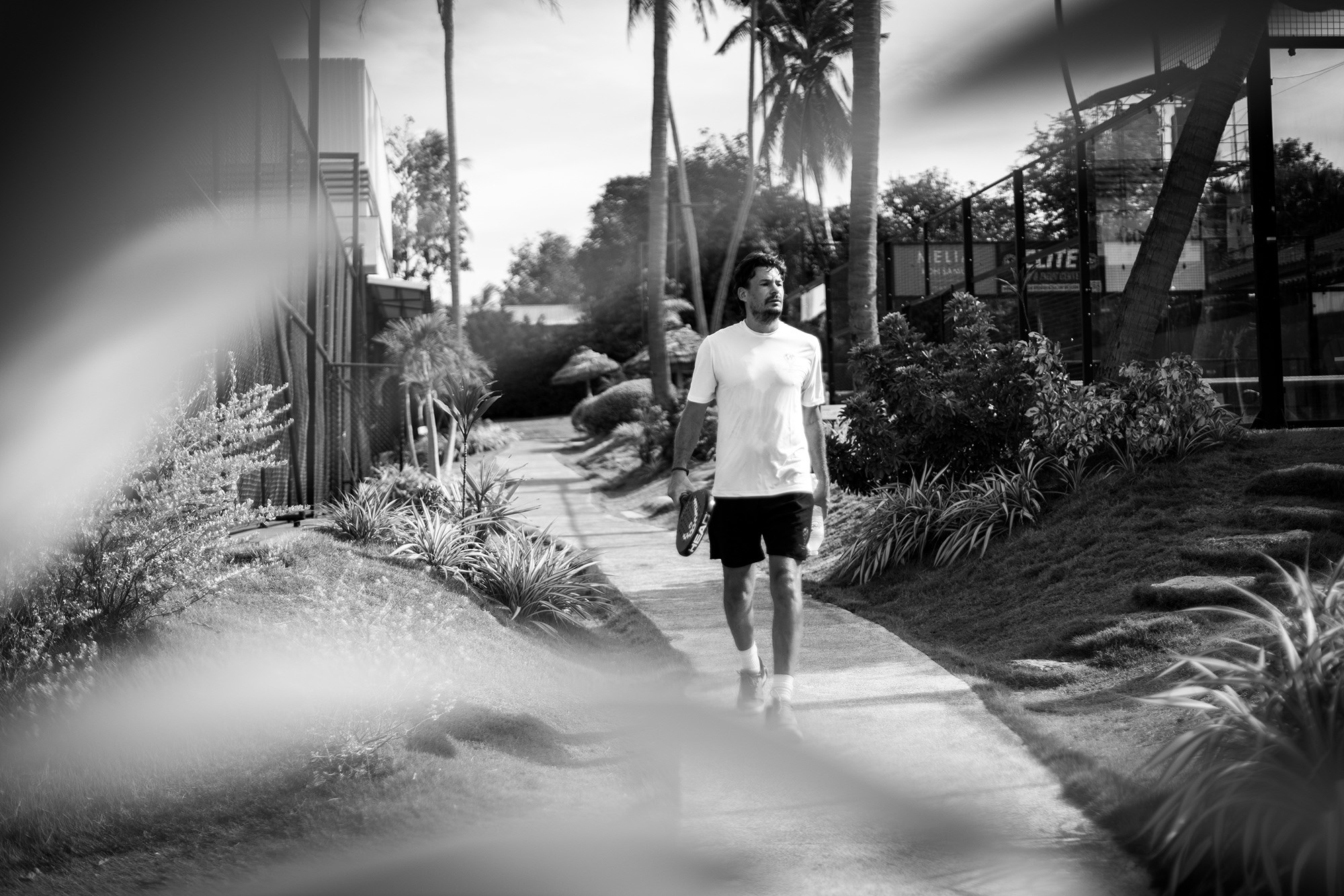
A weekend in Bangkok built around padel sounded like a good idea, except for one obvious complication: the traffic. Five games at six clubs over two days could easily mean seeing most of the city through a taxi window. But then we noticed how many clubs sat somewhere along the BTS, Bangkok’s elevated and surprisingly scenic train system. So that became the route. Racket over the shoulder. Tap in. Get off. Walk. Play. Repeat.
We started calling it: playing the line.
Somewhere between the stations and service lines, we found ourselves seeing a version of Bangkok we probably wouldn’t have gone looking for. Residential streets, neighbourhood cafés, restaurants chosen simply because they happened to be near the next court. Almost by accident, the game had started setting the itinerary.

Pad Thai - The introduction
Our first match was at Pad Thai, a name that removes any lingering doubt about where you’ve landed. Pap, one of the owners, had arranged a game and introduced us to TPS, The Padel Society, through which players find matches across the city. The club itself feels immediately warm and easy: beautifully put together, but without a sense of trying too hard, with the kind of atmosphere that makes you feel part of things almost as soon as you arrive. There’s a real community around it and an outdoor court good-looking enough to have found a second career in fashion shoots. Our fourth was a Thai player who’d recently competed at the FIP event at Pista. Within a few hours of landing, we were playing with someone we would never otherwise have met. It was a useful introduction to Bangkok padel: local, international and remarkably easy to enter. No membership committee. No lengthy initiation. Just turn up with a racket and know how to score.
@thaipadelseries / @padthaipadel

Kross Asoke: above the city
At Kross Asoke, the courts sit high enough for the skyline to rise behind the glass, turning the city into a fairly convincing backdrop. The sort that makes everyone reach for their phone between games. We found Freddie and Stan through the Kross app; two English guys young enough to be our children who were heading to Bali the following month. By the end of the match, we’d swapped numbers and another game, somewhere else in Asia, had been loosely proposed.
Sterling: the design one
We didn’t play at Sterling but we went to look – and it was worth the deviation. Here, the interesting bit is everything around the court. Tennis, padel and socialising have been considered together rather than as a collection of facilities that happen to share an address. It’s part of a wider shift in padel: the best new clubs understand that nobody necessarily wants to leave the second the game finishes. The coffee matters. The place you sit afterwards matters. Architecture, planting, changing rooms, lunch: none of it will improve your backhand, but it may improve your afternoon.
Kross Onnut: the neighbourhood club
Same brand, different Bangkok. Kross Onnut swaps Asoke’s cityscape for a more relaxed rhythm, with a pool, steam room and the sense that people actually stay once they’ve put the racket down. Our game came through TPS, this time with Ice from Thailand and Daniel from Germany. By now, what struck us was how international the courts were without anyone making much of it. Locals, expats, people passing through. Different ages, different languages, one fairly universal disagreement over whether that ball was actually out. Proof that some things travel well.
Baan: where it gets serious
Baan brought a different energy. Coaching was on court, international players were around the club, and Thai players were preparing for competition. Daria, from Russia, was already a friend; Christoph, from France, wasn’t. Sam completed the game through Playtomic. Here, the focus shifted decisively towards the padel itself. Bangkok’s social scene clearly hasn’t come at the expense of standards. Baan offered a glimpse of the more performance-led side of a city where the level appears to be rising almost as quickly as the number of courts.


Pista: thinking bigger
Pista required leaving the line for a short detour. The club had recently hosted an FIP event and was still evolving when we visited, but the ambition was already obvious. Owner Richard arranged our game, with German and Dutch players joining the mix. After neighbourhood clubs and rooftop courts, Pista felt like a destination: somewhere built to accommodate top level competition as comfortably as an everyday match. It made a fitting final stop. In 48 hours we had moved from a local introduction at Pad Thai to city views, considered design, neighbourhood clubs, performance courts and a venue with international ambitions.
The city between the games
We’d gone to Bangkok to review six padel clubs, yet by the end of the weekend that felt almost beside the point. Each one had shown us a different version of the game, but also a different version of the city: rooftop courts and neighbourhood hangouts, serious training grounds and places designed as much for what happens afterwards as the match itself. Along the way, the BTS took us to cafes we hadn’t planned on, streets we’d never have walked and games with Thai, British, German, Russian, French and Dutch players whose paths we would otherwise never have crossed. None of it would have happened without padel. There wasn’t one Bangkok padel scene to find, or one club that summed it up. The pleasure was discovering which version suited you. We’d gone to see the clubs, but padel showed us the city.
Passport. Wallet. Padel racket?
It’s the familiar check I make in the car on the way to the airport. The first two have always been there. The third is a relatively new addition to my pre-travel routine. Increasingly, if Sarah and I go somewhere, the rackets are coming too.
A weekend in Bangkok built around padel sounded like a good idea, except for one obvious complication: the traffic. Five games at six clubs over two days could easily mean seeing most of the city through a taxi window. But then we noticed how many clubs sat somewhere along the BTS, Bangkok’s elevated and surprisingly scenic train system. So that became the route. Racket over the shoulder. Tap in. Get off. Walk. Play. Repeat.
We started calling it: playing the line.
Somewhere between the stations and service lines, we found ourselves seeing a version of Bangkok we probably wouldn’t have gone looking for. Residential streets, neighbourhood cafés, restaurants chosen simply because they happened to be near the next court. Almost by accident, the game had started setting the itinerary.
Pad Thai - The introduction
Our first match was at Pad Thai, a name that removes any lingering doubt about where you’ve landed. Pap, one of the owners, had arranged a game and introduced us to TPS, The Padel Society, through which players find matches across the city. The club itself feels immediately warm and easy: beautifully put together, but without a sense of trying too hard, with the kind of atmosphere that makes you feel part of things almost as soon as you arrive. There’s a real community around it and an outdoor court good-looking enough to have found a second career in fashion shoots. Our fourth was a Thai player who’d recently competed at the FIP event at Pista. Within a few hours of landing, we were playing with someone we would never otherwise have met. It was a useful introduction to Bangkok padel: local, international and remarkably easy to enter. No membership committee. No lengthy initiation. Just turn up with a racket and know how to score.
@thaipadelseries / @padthaipadel
Kross Asoke: above the city
At Kross Asoke, the courts sit high enough for the skyline to rise behind the glass, turning the city into a fairly convincing backdrop. The sort that makes everyone reach for their phone between games. We found Freddie and Stan through the Kross app; two English guys young enough to be our children who were heading to Bali the following month. By the end of the match, we’d swapped numbers and another game, somewhere else in Asia, had been loosely proposed.
Sterling: the design one
We didn’t play at Sterling but we went to look – and it was worth the deviation. Here, the interesting bit is everything around the court. Tennis, padel and socialising have been considered together rather than as a collection of facilities that happen to share an address. It’s part of a wider shift in padel: the best new clubs understand that nobody necessarily wants to leave the second the game finishes. The coffee matters. The place you sit afterwards matters. Architecture, planting, changing rooms, lunch: none of it will improve your backhand, but it may improve your afternoon.
Kross Onnut: the neighbourhood club
Same brand, different Bangkok. Kross Onnut swaps Asoke’s cityscape for a more relaxed rhythm, with a pool, steam room and the sense that people actually stay once they’ve put the racket down. Our game came through TPS, this time with Ice from Thailand and Daniel from Germany. By now, what struck us was how international the courts were without anyone making much of it. Locals, expats, people passing through. Different ages, different languages, one fairly universal disagreement over whether that ball was actually out. Proof that some things travel well.
Baan: where it gets serious
Baan brought a different energy. Coaching was on court, international players were around the club, and Thai players were preparing for competition. Daria, from Russia, was already a friend; Christoph, from France, wasn’t. Sam completed the game through Playtomic. Here, the focus shifted decisively towards the padel itself. Bangkok’s social scene clearly hasn’t come at the expense of standards. Baan offered a glimpse of the more performance-led side of a city where the level appears to be rising almost as quickly as the number of courts.
Pista: thinking bigger
Pista required leaving the line for a short detour. The club had recently hosted an FIP event and was still evolving when we visited, but the ambition was already obvious. Owner Richard arranged our game, with German and Dutch players joining the mix. After neighbourhood clubs and rooftop courts, Pista felt like a destination: somewhere built to accommodate top level competition as comfortably as an everyday match. It made a fitting final stop. In 48 hours we had moved from a local introduction at Pad Thai to city views, considered design, neighbourhood clubs, performance courts and a venue with international ambitions.
The city between the games
We’d gone to Bangkok to review six padel clubs, yet by the end of the weekend that felt almost beside the point. Each one had shown us a different version of the game, but also a different version of the city: rooftop courts and neighbourhood hangouts, serious training grounds and places designed as much for what happens afterwards as the match itself. Along the way, the BTS took us to cafes we hadn’t planned on, streets we’d never have walked and games with Thai, British, German, Russian, French and Dutch players whose paths we would otherwise never have crossed. None of it would have happened without padel. There wasn’t one Bangkok padel scene to find, or one club that summed it up. The pleasure was discovering which version suited you. We’d gone to see the clubs, but padel showed us the city.
Share story
" height="300px" id="Hx9KOx1lf" width="302.0338983050847px"/></svg>)
" height="300px" id="xaZJkeOZX" width="298.98305084745766px"/></svg>)
More from the Journal.



THE VALERA DISPATCH
Served every Thursday
A curated weekly edit of stories worth reading, places worth finding and things we think you’ll like.

THE VALERA DISPATCH
Served every Thursday
A curated weekly edit of stories worth reading, places worth finding and things we think you’ll like.